



cornea,Eye Exam,Eye Health,Featured,Medical News
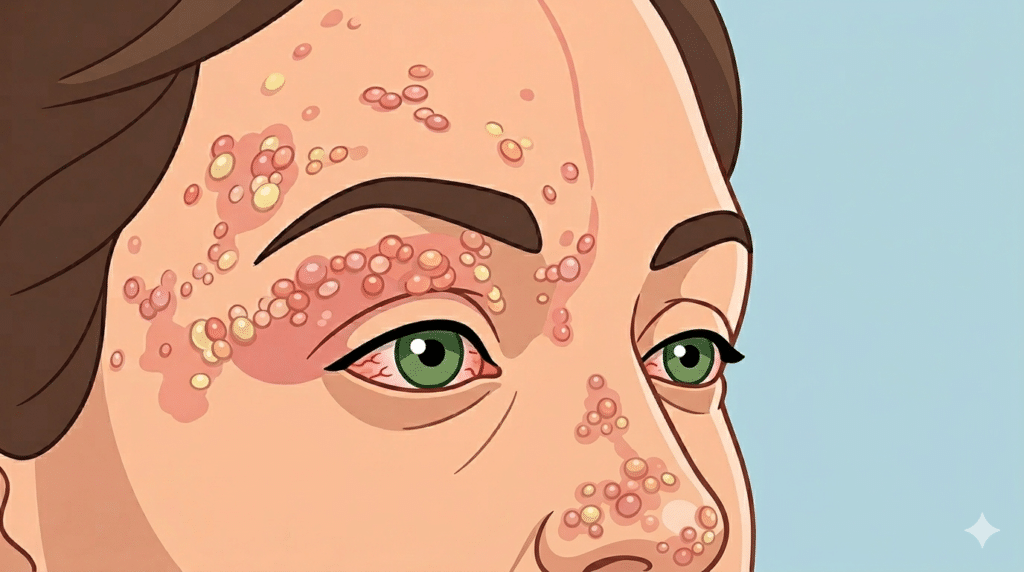
For most of us, chickenpox is a distant childhood memory—itchy spots, calamine lotion, and a week off school. But the virus behind it, varicella-zoster (VZV), doesn’t disappear when those spots heal. It retreats deep into the sensory nerves, where it can remain dormant for decades.
When the immune system weakens with age, stress, or illness, the virus can reawaken as shingles. While most cases affect the torso, a more dangerous form targets the face and eyes. This condition—Herpes Zoster Ophthalmicus (HZO), or Ocular Shingles—is not just painful. It can damage vision, inflame nerves, and raise your risk of stroke. Early detection, antiviral therapy, and prevention through vaccination can make all the difference.
If you develop facial pain, tingling, or a rash near your eye, don’t wait.
Early assessment can protect your vision before irreversible changes occur.
The 72-Hour Rule That Protects Vision
When shingles affects the eye, time truly equals vision. The first 72 hours after the rash appears are critical. Starting antiviral therapy—such as acyclovir, valacyclovir, or famciclovir—during this window can dramatically reduce complications.
Beyond that period, the virus can invade the cornea and internal eye tissues, leading to chronic inflammation, glaucoma, and permanent vision loss. Many people delay care because they assume the rash must worsen before seeking help. But by the fourth day, the damage may already be taking hold.
Immediate evaluation by an eye care professional ensures that antiviral and anti-inflammatory therapies can begin.
The Nose Knows: A Telltale Warning Sign
A century-old clinical clue remains just as useful today. Hutchinson’s sign—shingles blisters on the tip or side of the nose—is a well-known predictor of ocular involvement. The reason is purely anatomical: the same branch of the trigeminal nerve supplies both the nose and the eye.
If the virus is active on the nose, it has likely reached the pathways that lead directly to the cornea. Yet even without this sign, about one-third of patients still develop eye complications. The message is clear: every case of facial shingles deserves expert eye assessment, regardless of where the rash appears.
When a “One-Sided” Rash Reaches Both Eyes
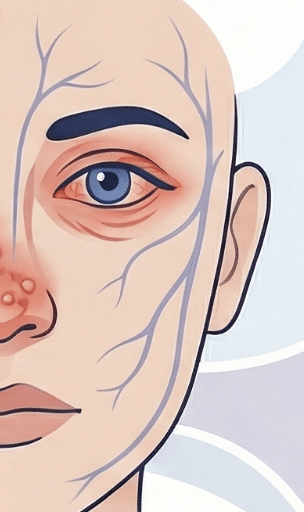
Ocular shingles appears to be a one-sided disease. The rash almost never crosses the facial midline, giving the impression that the unaffected eye is safe. But advanced imaging has revealed a more complicated story.
Research using In Vivo Confocal Microscopy (IVCM)—a high-resolution method that visualizes corneal nerves—has shown that even in patients who appear to have one-sided disease, both corneas often show nerve fiber loss. This suggests a deeper, central nervous system process affecting both sides at once.
In other words, ocular shingles is not simply a surface infection—it’s a disorder with far-reaching neurological effects, reinforcing why comprehensive eye evaluation is essential in every case.
The Brain–Eye Connection: A Hidden Stroke Risk
As researchers uncover more about ocular shingles, one finding stands out. Patients who experience HZO face a 4.3 times greater risk of stroke within one year of the infection compared with the general population.
This stems from inflammation in the blood vessels that run alongside the trigeminal nerve, which services both the face and critical brain arteries. A virus that starts in the eye region can therefore trigger vascular damage and clot formation—turning an eye disease into a potential neurological emergency.
This discovery marks HZO as not only an ophthalmic urgency but also a condition with systemic health implications.
Prevention Begins Before the Rash
The good news is that ocular shingles can often be prevented. For adults over 50, the Shingrix vaccine offers more than 97% protection against shingles and its complications, including those affecting the eyes.
Given the aging population and natural decline of immune defense with time, vaccination is increasingly being viewed as the first line of protection for long-term nerve and visual health.
At North Toronto Eye Care, our comprehensive ophthalmologists are trained to diagnose and manage complex conditions such as ocular shingles using advanced corneal imaging and customized treatment plans. If you suspect shingles around your eye or would like to discuss prevention, we invite you to book an appointment today.
Your eyes deserve expert protection—before the countdown begins.
References
- https://www.aafp.org/pubs/afp/issues/2002/1101/p1723.html
- Minor M, Gurnani B, Payne E. Herpes Zoster Ophthalmicus. [Updated 2025 Sep 14]. In: StatPearls [Internet]. Treasure Island (FL): StatPearls Publishing; 2026 Jan-. Available from: https://www.ncbi.nlm.nih.gov/books/NBK557779/
- https://iovs.arvojournals.org/article.aspx?articleid=2768993
- https://www.willseye.org/herpes-zoster-ophthalmicus-ocular-shingles/
- https://myhealth.alberta.ca/Health/aftercareinformation/pages/conditions.aspx?hwid=ack4333
- https://dash.harvard.edu/server/api/core/bitstreams/7312037e-32da-6bd4-e053-0100007fdf3b/content