



Featured,Glaucoma,Medical News,Medical Technology,What's New

Interventional Glaucoma Management
For decades, glaucoma has been known as the “silent thief of sight.” Traditionally, that diagnosis marked the beginning of a lifelong routine of daily eye drops—a constant reminder of the condition. Thanks to groundbreaking research and advanced technology, we are entering a new era of glaucoma treatment—one that empowers patients with simpler, longer‑lasting, and more effective ways to protect their vision.
At North Toronto Eye Care, our glaucoma specialists offer innovative options and personalized treatment plans that reduce or even eliminate the need for daily drops.
The Hidden Challenge of Daily Drops
Many patients find staying consistent with daily eye drops surprisingly difficult—and research shows they’re not alone. Studies indicate that up to 50% of people with glaucoma don’t use their medication as prescribed. Because early glaucoma is symptom‑free, skipping doses doesn’t cause immediate discomfort, making it easy to underestimate the risk. This pattern, known as “white coat compliance,” can even hide poor adherence during routine eye exams.
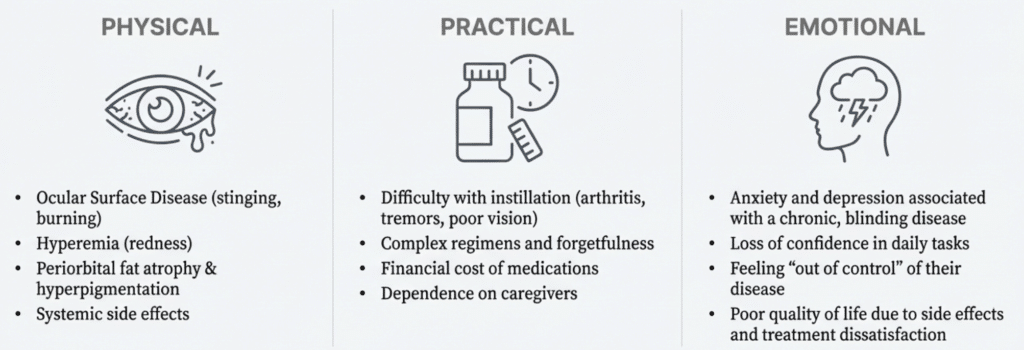
Furthermore the daily burden of drops extends far beyond the eye as it contributes to physical, practical, and emotional challenges.
That’s why lowering intraocular pressure (IOP) consistently—not occasionally—is the key to protecting vision. And it’s also why newer treatments aim to take adherence out of the equation entirely.
What is the Modern Approach: Interventional Glaucoma
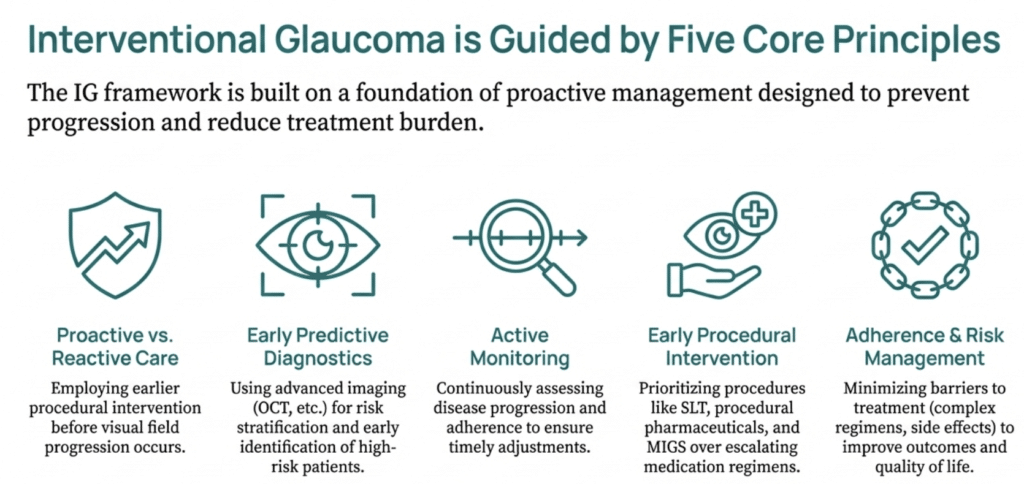
For decades, glaucoma treatment followed the same ladder: start with drops, add more drops, and only later consider laser or surgical options. But a modern approach called Interventional Glaucoma is changing that model from reactive to proactive care.
The First Treatment May No Longer Be Eye Drops: Early Procedural Interventions
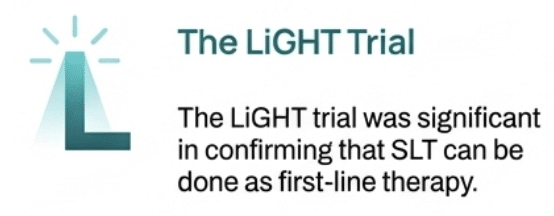
The pivotal LiGHT trial compared traditional drop therapy with initial SLT laser treatment and found eye‑opening results:
- SLT was just as effective as drops for controlling pressure.
- Three‑quarters of patients treated with laser didn’t need drops for at least three years.
- Patients experienced fewer side effects and lower overall costs.
This paradigm shift means patients can begin with a simple, painless in‑office laser procedure that delivers lasting control without the daily routine.

MIGS stands for minimally invasive (or micro-invasive) glaucoma surgery and includes a range of stents, implants, and angle procedures rather than a single operation. It is a procedure that is frequently combined with cataract surgery for additional IOP and medication reduction in glaucoma patients.
The HORIZON trial showed that adding a Hydrus Microstent to cataract surgery provides greater and more durable IOP and medication reduction than cataract surgery alone, with similar safety over at least 5 years.
The Future: Tiny Implants, Big Results
For those who still need medication, sustained‑release implants are redefining what glaucoma management looks like. These microscopic devices continuously deliver medicine inside the eye for months—or even years—from a single treatment.
Currently FDA approved but not yet Health Canada approved implant:
- Durysta® (bimatoprost implant): A biodegradable insert that dissolves naturally but can continue lowering pressure for up to two years in some patients.
Clinical studies have revealed Durysta’s effect can outlast the implant itself, suggesting long‑term remodeling of the eye’s drainage system. This “set‑it‑and‑forget‑it” approach frees patients from daily dosing while maintaining steady, around‑the‑clock eye pressure control.
Talk to Your Glaucoma Specialist
All of these innovations point toward a new truth in eye care: patients don’t have to manage glaucoma alone or depend entirely on daily drops. Our specialists follow by the principles of Interventional Glaucoma Management for early, effective, and minimally invasive strategies that protect sight while reducing everyday burden.
Our glaucoma specialists at North Toronto Eye Care can help you explore personalized options designed to fit your lifestyle and protect your vision for life.
Book your consultation today and take the next step into the future of glaucoma care.
References
- https://www.glaukos.com/wp-content/uploads/2025/07/Gallardo-2024_-Interventional-glaucoma-and-the-patient-perspective.pdf
- Robin A, Grover DS. Compliance and adherence in glaucoma management. Indian J Ophthalmol. 2011 Jan;59 Suppl(Suppl1):S93-6. doi: 10.4103/0301-4738.73693. PMID: 21150041; PMCID: PMC3038505.
- https://www.mdpi.com/2077-0383/12/1/151
- https://www.ophthalmologytimes.com/view/innovations-in-glaucoma-poised-for-breakthrough-in-2026-and-what-might-hold-the-back-
- Gurnani B, Tripathy K. Minimally Invasive Glaucoma Surgery. [Updated 2023 Aug 25]. In: StatPearls [Internet]. Treasure Island (FL): StatPearls Publishing; 2025 Jan-. Available from: https://www.ncbi.nlm.nih.gov/books/NBK582156/
- https://crstodayeurope.com/articles/advancing-glaucoma-care-embracing-early-interventional-approaches-to-improve-patients-quality-of-life/toward-a-proactive-approach-in-glaucoma-management/
- Shirley M. Bimatoprost Implant: First Approval. Drugs Aging. 2020 Jun;37(6):457-462. doi: 10.1007/s40266-020-00769-8. Erratum in: Drugs Aging. 2020 Jul;37(7):549. doi: 10.1007/s40266-020-00778-7. PMID: 32447639; PMCID: PMC7303088.