



Cataract,Eye Exam,Eye Health,Medical News,Medical Technology,Presbyopia,Refractive Lens Exchange,What's New
You’re at a restaurant, and the menu suddenly looks blurry. You stretch your arm to find the right distance and squint under the light — the familiar “presbyopia stretch” after age 40. This gradual loss of near vision is a normal part of aging, but the options for correction have expanded well beyond reading glasses.
One of the most talked-about developments is presbyopia-correcting eye drops. These prescription drops aim to temporarily improve near vision without lenses, offering a new addition to the spectrum of presbyopia treatment options that includes glasses, contact lenses, refractive lens exchange, and laser procedures.
While these drops are not approved by Health Canada, they are FDA approved in the United States and represent an exciting development in vision science. Here’s what you should know about this innovative technology.
How They Work
Most of these drops work by gently constricting the pupil to create a “pinhole effect.” This increases the eye’s depth of focus, improving near vision. Finding the right balance is key — too much constriction can darken vision or reduce contrast. The science behind these formulations continues to evolve to optimize comfort, clarity, and duration.
The Expanding Field
The first FDA-approved option, Vuity (pilocarpine 1.25%), launched in 2021, followed by newer entrants such as Qlosi and Vizz, each with unique strengths and formulations.1,2 More options are expected, like combination drops that pair medications to extend the duration of effect. Some newer trials show benefits lasting up to 8–10 hours — a significant improvement from earlier generations.3
This growing competition is excellent news for patients, driving innovation and expanding opportunities for more tailored treatments.
Benefits and Safety Considerations
While presbyopia drops have generated excitement, they are still prescription medications — not a cosmetic fix. In rare cases, miotic eye drops (those that constrict the pupil) have been linked to retinal detachment, particularly in patients with pre-existing risk factors like high myopia or thinning of the retina.4
Before starting any presbyopia treatment, a comprehensive dilated eye exam is essential to determine candidacy and ensure retinal health. Patients should also be educated on warning signs like flashes of light, new floaters, or shadowed areas in vision and seek immediate care if these occur.
The Bigger Picture: A Range of Options
At North Toronto Eye Care, we believe patients should be fully informed about all available and emerging treatments. Presbyopia-correcting drops are part of a broader spectrum of correction options, each with advantages depending on your visual needs, lifestyle, and ocular health.
Although not yet available in Canada, these drops reflect the rapid pace of innovation in vision care — a glimpse into the future of managing near vision loss.
With any medical decision, the best choice is an individualized and guided by an expert evaluation and conversation with your eye care provider.
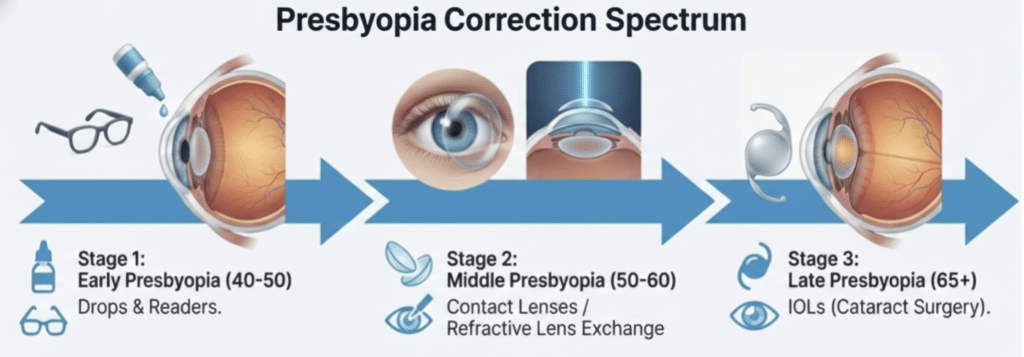
Where you might fit in this spectrum
With each stage of presbyopia comes the introduction of different options to consider for presbyopia correction.
Many start with readers or progressive glasses. For those looking for flexible “on-demand” solutions without glasses may consider presbyopia drops for specific activities like dinners, meetings, or events.
Reading glasses (“readers”) are widely available and can be either prescribed by your optometrist for specific near tasks or generic magnifiers can be found at your local drug store. Although often the first go-to solution for emerging presbyopia, they can be inconvenient to carry, easy to lose, and do not correct distance vision.
Patients with increasing lens changes and needing increased reliance on glasses may consider contact lenses or RLE with presbyopia-correcting IOL if looking for less dependence on glasses.
Refractive lens exchange (RLE) replaces the natural lens with a premium intraocular lens (IOL), often multifocal or extended‑depth‑of‑focus, to provide long‑term correction of presbyopia and other refractive errors before cataracts develop. This is typically considered for patients in their 50s or older who want a more permanent solution and are comfortable with surgery.
Multifocal or monovision contact lenses can give hands‑free near vision and work well for many active adults, but they demand good ocular surface, careful fitting, and some patients notice halos or reduced contrast, especially at night.
As cataracts develop, cataract surgery with a presbyopia‑correcting IOL usually becomes the most comprehensive option.
Cataract surgery with presbyopia‑correcting IOLs becomes the main strategy once a visually significant cataract is present, addressing both cloudy vision and focus at multiple distances in a single procedure.
North Toronto Eye Care can help customize a presbyopia strategy that may include readers, contact lenses, eye drops, or lens surgery, depending on your goals, occupation, and eye health. If you are curious about presbyopia‑correcting drops—or wondering when to move beyond readers—booking a comprehensive exam is the safest first step.
References
- Aslam HG, Fatima M, Sajid H, Irshad NUN, Imran SB. FDA approval of aceclidine (Vizz): a new chapter in nonsurgical presbyopia management. Ann Med Surg (Lond). 2025 Sep 30;87(11):6967-6969. doi: 10.1097/MS9.0000000000004008. PMID: 41180743; PMCID: PMC12577907.
- https://eyewiki.org/Vuity
- https://www.ophthalmologytimes.com/view/the-emerging-era-of-presbyopia-correcting-eye-drops-what-s-next-
- https://ascrs.org/-/media/files/clinical-committee-reports/vuity-consensus-statement_october-2022.pdf