




Aesthetics,Blepharoplasty,Eye Health,Featured,Medical News,Oculoplastics,What's New
Under-eye hollows and puffiness are common concerns we see in our oculoplastics clinic. While many people assume they’re simply signs of aging or lack of sleep, the reality is much more complex. The appearance of tired eyes is usually caused by changes in the skin, fat, muscles, and bone around the eyes—not simply fatigue.
The good news is that understanding why under-eyes look the way they do is the first step toward choosing the right treatment.
Why Do Our Eyes Show Age First?
The skin surrounding the eyes is unique; it is the thinnest, most delicate skin anywhere on the body. Because it lacks the structural thickness found elsewhere on the face, it acts like a window, readily revealing the anatomical shifts occurring just beneath the surface.
With age, several natural, interconnected biological changes happen simultaneously:
- Slowing Collagen Production: The skin loses its foundational proteins (collagen and elastin), becoming thinner and more translucent.
- Fat Pad Migration: The protective fat pads that cushion the eyes begin to shift out of place.
- Bone Remodeling: The facial bones—specifically the orbital rim (eye socket)—gradually recede and widen.
- Lax Muscles: The structural ligaments loosen, and the orbicularis oculi (the muscle responsible for blinking and squinting) loses its tone.
Individually, these changes are subtle. Together, they create a cascade of shadows, hollows, wrinkles, and puffiness that can create the appearance of being chronically fatigued.
Under-Eye Hollows vs. Under-Eye Puffiness
One of the biggest misconceptions encountered is the belief that under-eye bags and under-eye hollows are the same problem. They are actually two distinct structural conditions, and treating them effectively requires entirely different clinical approaches.
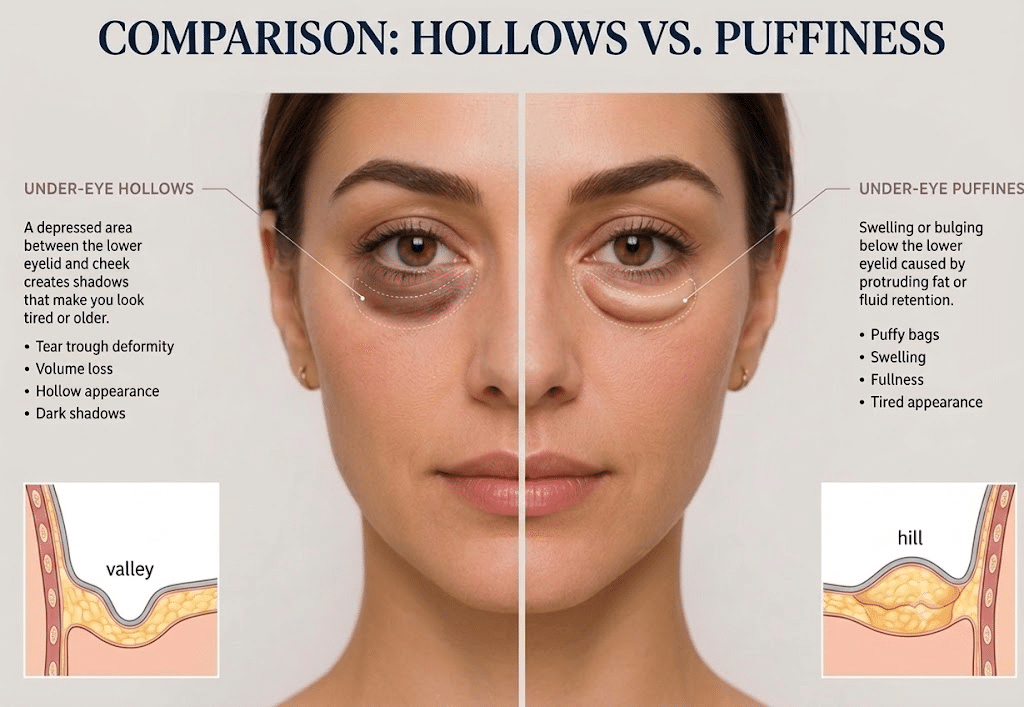
Under-Eye Hollows (Tear Troughs)
Under-eye hollows—medically referred to as tear trough deformities—are distinct depressions that run between the lower eyelid and the upper cheek. These hollows cast a shadow across the lower lid, making the eyes look sunken, aged, or dark.
Clinical Insight: In many cases, “dark circles” are not caused by dark skin pigmentation at all. Instead, they are simply a physical shadow cast by a deep tear trough.
Common causes include:
- Genetics: Inherited facial bone structures that naturally lack forward projection.
- Age-Related Volume Loss: The natural depletion of the deep fat pads in the midface and cheeks.
- Orbital Bone Remodeling: The gradual widening of the eye socket over time.
- Thinning Skin: Allowing the dark, underlying structural contours to become highly visible.
Under-Eye Puffiness (Eye Bags)
Puffiness represents a forward protrusion of volume.
Deep inside the eye socket, natural fat pads cushion the globe. In youth, a thin, fibrous membrane called the orbital septum acts as a retaining wall, keeping this fat tucked away. Over time, the orbital septum weakens and stretches. This allows the fat pads to prolapse (bulge forward), creating permanent under-eye bags.
Common causes include:
- Genetics and familial traits.
- Age-related weakening of connective tissues.
- Chronic inflammation or fluid retention from allergies or high sodium intake.
The “Mountain-and-Valley” Effect
Many patients do not experience just one of these conditions—they experience both simultaneously. When a protruding fat pad (the mountain) sits directly above a deep tear trough hollow (the valley), the contrast creates severe shadowing. This combination is what most often drives patients to seek expert intervention.
Advanced Treatment Options: Finding Your Right Fit
At North Toronto Eye Care, our approach to periorbital rejuvenation is completely customized. We evaluate everyone’s unique anatomy to match with the right tier of care.
Non-Surgical Options
Sometimes, the best initial treatment involves no procedures at all. Managing seasonal allergies, reducing dietary salt intake, prioritizing sleep quality, and protecting the skin from UV damage can significantly minimize temporary fluid retention and skin thinning.
For patients with true volume loss (deep tear troughs) and good skin elasticity, targeted injections of Hyaluronic Acid (HA) fillers can work wonders. Fillers restore lost volume, smoothly bridge the transition between the lower eyelid and the cheek, and eliminate the shadows causing dark circles.
Note: If a patient has significant fat puffiness, adding filler can backfire, making the lower lid look heavier or fluid-filled. An expert assessment is crucial.
While Botox® does not treat eye bags or hollows directly, it relaxes the dynamic muscles around the eyes. This softens crow’s feet and creates a more rested, bright-eyed appearance that beautifully complements volume restoration treatments.
Surgical Interventions (Oculoplastics)
For prominent, permanent under-eye bags caused by protruding fat, a lower blepharoplasty provides the most predictable and long-lasting results.
Modern eyelid surgery is highly sophisticated. Instead of aggressively cutting out fat—which can leave the eyes looking hollowed out or “skeletonized” later in life—our oculoplastic surgeons specialize in fat repositioning. We move the patient’s natural fat out of the “bag” and drop it into the “hollow” below, beautifully smoothing the transition from the eye to the cheek.
Often, patients focus on their lower eyelids when it is actually heavy, drooping upper eyelids that are making them look tired. An upper blepharoplasty removes hooded, excess skin. This re-establishes a clean upper eyelid crease, reduces heaviness, and can even restore peripheral vision if the sagging skin is blocking your sight line.
Why Choosing an Oculoplastic Surgeon Matters
The tissues, muscles, and delicate mechanics surrounding the eye are measured in millimeters. Treatments that work beautifully for one individual can cause complications or unnatural results in another if the surgeon does not fully comprehend the intricate anatomy of the eye area.
An oculoplastic surgeon is a board-certified ophthalmologist who has completed intensive training specializing exclusively in plastic and reconstructive surgery of the eyelids, orbit, and lacrimal (tear production) system.
Considerations for our surgeons to understand the full picture:
- Skin quality and elasticity
- Fat distribution and orbital septum strength
- Eyelid positioning and blink function
- Midface volume and overall facial balance
Rather than applying a one-size-fits-all treatment, our surgeons design a customized map to restore a refreshed and natural image.
Frequently Asked Questions (FAQs)
Ready to Rediscover Your Rested Self?
The journey to brighter eyes doesn’t start with choosing a procedure; it starts with understanding anatomy.
If you are tired of looking fatigued when you feel vibrant and ready for the day, let our team help. Contact North Toronto Eye Care today to schedule a comprehensive consultation with one of our oculoplastic surgeons. Together, we will create a tailored treatment plan that brings out the very best in your eyes.
References
- American Academy of Ophthalmology. Patient education resources on eyelid surgery and periocular aging.
- American Society of Ophthalmic Plastic and Reconstructive Surgery. Patient education on eyelid aging and blepharoplasty.
- Fat Repositioning in Blepharoplasty: Goldberg RA. Transconjunctival Orbital Fat Repositioning: My Thrice-Evolved Technique. Dermatologic Surgery.
- Anatomy of the Periorbital Region: Rebowe RE, Larson JD, et al. Anatomy of the Periorbital Region and Forehead. Clinics in Plastic Surgery.
- Pathophysiology of Tear Trough Deformity: Haddock NT, et al. Lower Eyelid and Midface Rejuvenation: Anatomy, Tear Trough Deformity, and Fat Grafting. Integrated Journal of Aesthetic Surgery.