



Eye Exam,Eye Health,Featured,Medical News,Retina,What's New
What if a medication prescribed to millions of people for diabetes and weight loss carried a rare side effect that could cause someone to wake up with sudden, permanent vision loss in one eye? In late 2026, the U.S. Food and Drug Administration (FDA) required manufacturers of all glucagon-like peptide-1 receptor agonists (GLP-1 RAs) to update their safety labels with a warning regarding non-arteritic anterior ischemic optic neuropathy (NAION)—a rare optic-nerve condition that can cause sudden, painless vision loss.
Health Canada had already taken action earlier: in September 2026, the Canadian product monograph for Wegovy (semaglutide) was updated to include NAION under Warnings and Precautions. Health Canada advises that semaglutide be discontinued if NAION occurs.
Anatomy of a Warning: GLP-1 RAs and NAION
To understand the FDA’s classwide warning, we must first examine both the drug class involved and the eye condition at the centre of the regulatory action.
Glucagon-like peptide-1 receptor agonists (GLP-1 RAs) mimic a naturally occurring intestinal hormone that stimulates insulin secretion, lowers blood glucose after meals, slows gastric emptying, and acts on brain centres that regulate appetite. Beyond type 2 diabetes and long-term weight management, several medications in this class have approvals or indications related to cardiovascular risk reduction, chronic kidney disease, obstructive sleep apnea, and metabolic dysfunction-associated steatohepatitis.
The FDA’s November 9, 2026 action applies across the GLP-1 RA class, rather than to semaglutide alone. Affected single-agent and combination therapies include:
- Exenatide (Byetta; the application was voluntarily withdrawn)
- Liraglutide (Victoza, Saxenda) and liraglutide plus insulin degludec (Xultophy)
- Dulaglutide (Trulicity)
- Lixisenatide plus insulin glargine (Soliqua)
- Semaglutide (Ozempic, Rybelsus, Wegovy)
- Tirzepatide (Mounjaro, Zepbound), a dual GIP/GLP-1 receptor agonist
- Orforglipron (Foundayo), an oral small-molecule GLP-1 receptor agonist
What Is NAION?
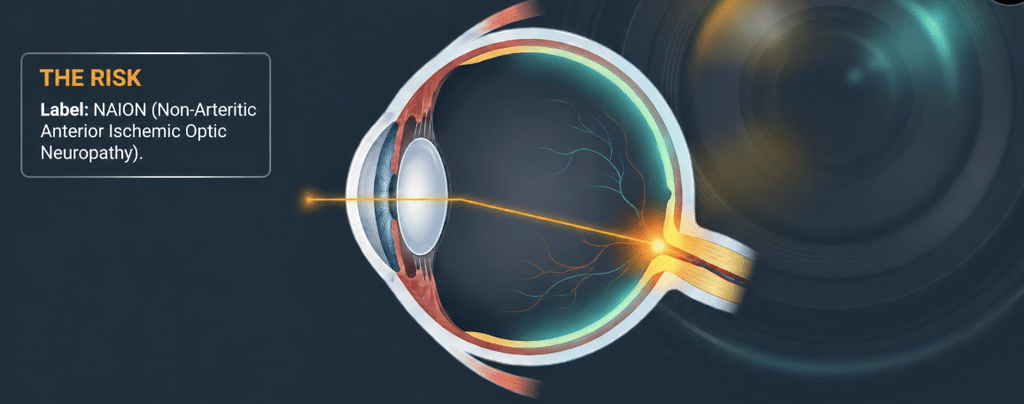
Non-arteritic anterior ischemic optic neuropathy (NAION) is sometimes described as a “stroke of the optic nerve.” The optic nerve acts like a bundle of fibre-optic cables, carrying visual signals from the retina to the brain. The front portion of the nerve, where it enters the back of the eye, is called the optic disc.
NAION occurs when blood flow to the optic disc is suddenly reduced. This leads to acute hypoperfusion, tissue swelling, and damage to retinal ganglion-cell axons. Patients often notice sudden, painless vision loss in one eye—sometimes immediately upon waking.
Systemic risk factors for NAION include hypertension, diabetes, high cholesterol, smoking, sleep apnea, anemia, and chronic kidney disease. An anatomical feature called a “disc at risk”—an optic nerve head with a small or absent central cup and tightly crowded tissue—may also increase vulnerability. In such eyes, even mild swelling within the confined space at the optic disc can compromise blood flow.
When Did Regulators Act?
| Regulator | Action | Scope |
|---|---|---|
| Health Canada | Updated the Canadian Wegovy (semaglutide) product monograph in September 2026 to include NAION as a very rare possible adverse event and to advise discontinuation if NAION occurs | Semaglutide / Wegovy |
| FDA | Issued a Drug Safety Communication on November 9, 2026, requiring updated Warnings and Precautions labelling | All marketed GLP-1 RAs |
The FDA’s decision to apply the warning across the class was based in part on postmarketing safety reports involving every marketed GLP-1 RA. The European Medicines Agency (EMA), by contrast, updated product information for semaglutide products specifically in mid-2025, classifying NAION as a “very rare” side effect that may affect up to 1 in 10,000 people using semaglutide for at least one year.
Weighing the Evidence
The scientific signal gained widespread attention in July 2024, when Hathaway and colleagues published a study in JAMA Ophthalmology reporting an association between semaglutide and NAION in a neuro-ophthalmology clinic cohort.
However, that study had important limitations where people prescribed GLP-1 medications may differ from comparison groups in ways that affect both their eye risk and their likelihood of being referred to a specialist.
The FDA pooled data from 126 randomized clinical trials involving 134,253 patients and 288,879 person-years of exposure. Investigators identified 15 probable NAION cases: 10 among people treated with a GLP-1 RA and 5 among people receiving placebo.
This corresponds to approximately:
- 6.4 cases per 100,000 person-years in GLP-1 RA-treated patients
- 3.8 cases per 100,000 person-years in placebo-treated patients
For context, the background incidence of NAION in the general population over age 50 is often estimated at roughly 2.3 to 10.2 cases per 100,000 people per year. The absolute risk associated with GLP-1 use therefore remains low, even if a modest relative increase exists.
The FDA also retrospectively reviewed real-world data from its Sentinel commercial network between 2019 and 2024, focusing on adults with type 2 diabetes. NAION incidence ranged from 26 to 32 cases per 100,000 person-years across treatment groups.
The Ocular Paradox
A key question is how a medication class could be associated with a rare optic-nerve ischemic event while also offering potential long-term protection against severe diabetic eye disease.
A 2025 cohort study by Ramsey and colleagues in JAMA Network Open evaluated more than 185,000 propensity-score-matched patients with type 2 diabetes. It found a modest 7% increase in incident diabetic retinopathy among GLP-1 RA users.
At the same time, among patients who already had diabetic retinopathy, GLP-1 RA use was associated with substantially fewer severe complications:
- 26% reduction in vitreous hemorrhage
- 22% reduction in neovascular glaucoma
- 30% reduction in new-onset blindness
This creates an important clinical distinction: NAION affects the optic nerve, while diabetic retinopathy affects the retina and its small blood vessels. A person can be at risk for either condition, and regular dilated eye examinations remain essential for people with diabetes.
Why Might NAION Occur?
The exact mechanism linking GLP-1 RAs to NAION has not been proven. The FDA’s review of animal data did not identify a direct mechanism by which GLP-1 RAs cause optic-nerve toxicity; in fact, GLP-1 receptor activation has shown neuroprotective effects in some retinal-disease models.
Two leading hypotheses are being considered:
Rapid glycemic drop
A rapid, substantial reduction in blood glucose—such as a steep HbA1c decline within the first 16 weeks of treatment—may alter tissue osmolality and temporarily increase microvascular permeability. In an eye with a “disc at risk,” mild swelling could create a compartment-like effect, compressing small posterior ciliary arterioles and reducing blood flow to the optic disc.
Vascular regulation
GLP-1 receptor activation can stimulate endothelial nitric oxide synthase (eNOS), promoting vasodilation. Although this may support cardiovascular health, changes in microvascular regulation at the optic nerve head could theoretically disrupt blood-flow autoregulation or contribute to a “vascular steal” effect. These mechanisms remain hypotheses rather than established causes.
What Symptoms Require Urgent Care?
Patients using GLP-1 RAs should seek same-day assessment from an optometrist, ophthalmologist, or emergency department if they develop:
- Sudden, painless vision loss in one eye, especially noticed upon waking
- A new blind spot, dark area, or “curtain” in the vision
- Loss of the upper or lower half of the visual field
- Tunnel vision
- Blurred or hazy central vision
- Colour distortion or reduced central sharpness
- Any abrupt, unexplained change in vision
If NAION is suspected, the patient should be referred promptly for a comprehensive dilated eye examination, visual-field testing, and optical coherence tomography (OCT).
Should You Stop Your GLP-1?
Do not stop a prescribed GLP-1 medication on your own. The FDA advises clinicians to consider discontinuation if NAION develops, unless the benefits of continued treatment clearly outweigh the risks.
Joint guidance from the North American Neuro-Ophthalmology Society (NANOS) and the American Academy of Ophthalmology (AAO) emphasizes that automatic discontinuation is not necessarily appropriate for every patient. Stopping a GLP-1 RA may have consequences for glycemic control, weight management, kidney disease, and cardiovascular risk.
If NAION occurs in one eye, there may be an increased risk of involvement in the other eye, but the absolute risk remains very low. Decisions should be individualized through shared decision-making among the patient, family doctor, endocrinologist, cardiologist, and eye-care provider.
What North Toronto Eye Care Recommends
At North Toronto Eye Care, we recommend that patients taking GLP-1 medications:
- Learn the warning symptoms of NAION and treat sudden vision changes as urgent
- Attend regular comprehensive eye examinations, especially if they have diabetes, sleep apnea, glaucoma risk, or a history of optic-nerve disease
- Tell their eye doctor that they use a GLP-1 medication
- Avoid self-discontinuing medication without first speaking with the prescriber
- Seek immediate assessment for new, painless vision loss in one eye
References
- U.S. Food and Drug Administration. FDA Requires Safety Labeling Changes for Glucagon-Like Peptide-1 Receptor Agonists (GLP-1 RAs) Due to Potential Increased Risk of Rare But Serious Eye Condition. November 9, 2026.[fda]
- U.S. Food and Drug Administration. MedWatch Alert: FDA Requires Safety Labeling Changes for GLP-1 RAs Due to Potential Increased Risk of Rare But Serious Eye Condition.[fda]
- Health Canada Drug Product Database. WEGOVY (semaglutide) Product Monograph, including NAION warnings and precautions.
- Hathaway JT et al. Risk of Nonarteritic Anterior Ischemic Optic Neuropathy in Patients Prescribed Semaglutide. JAMA Ophthalmology. 2024.[harrismartin]
- Ramsey DJ et al. GLP-1 Receptor Agonists and Diabetic Retinopathy Outcomes. JAMA Network Open. 2025.
- European Medicines Agency. Semaglutide product-information update regarding NAION.