



Cataract,cornea,Eye Health,Featured,Glaucoma,Intraocular Lens,Keratoconus,LASIK,Medical News,Medical Technology,What's New
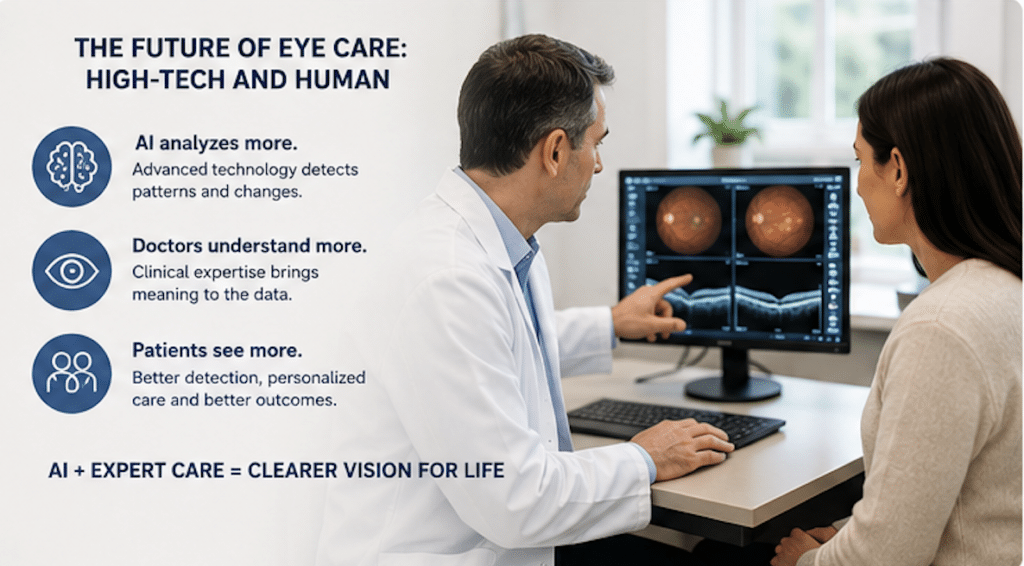
Most people think of artificial intelligence as something that belongs in smartphones, search engines, or futuristic robots. But AI is already becoming part of modern medicine — and eye care is one of the fields where it may have the greatest impact.
Why the eyes? Because eye care relies heavily on data.
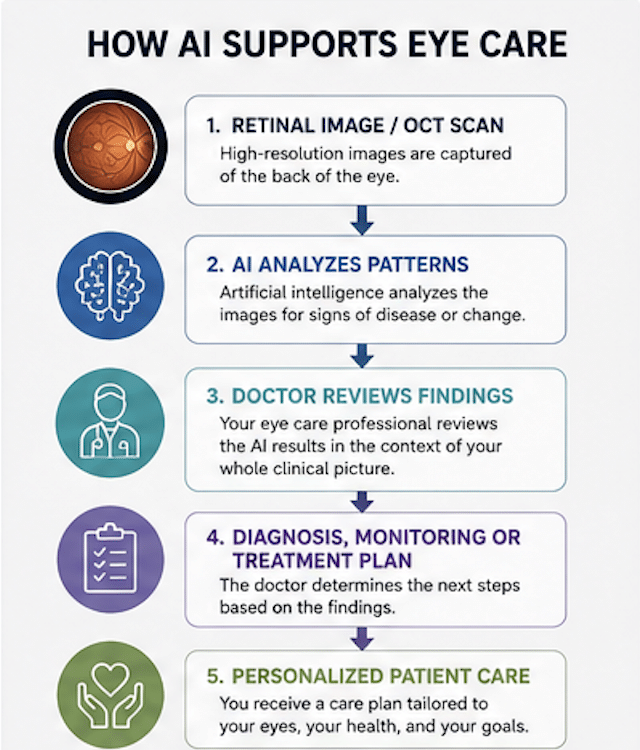
Retinal photographs, OCT scans, visual fields, corneal maps, and surgical measurements all contain patterns that trained eye care professionals use to detect disease, monitor change, and plan treatment. Artificial intelligence can help analyze these patterns quickly and consistently, giving doctors another powerful tool to support diagnosis and patient care.
At North Toronto Eye Care, we believe technology is most valuable when it supports something deeply human: careful listening, expert judgment, and personalized care. AI does not replace your ophthalmologist or optometrist. Instead, it is becoming an additional layer of support — helping doctors detect disease earlier, follow progression more precisely, and make more informed decisions.
What Is AI in Eye Care?
Artificial intelligence refers to computer systems that are trained to recognize patterns, make predictions, or support decisions based on large amounts of data. In eye care, this often means teaching software to analyze medical images.
For example, an AI system may be trained on thousands or millions of retinal images. Over time, it learns to recognize features associated with eye diseases such as diabetic retinopathy, glaucoma, or age-related macular degeneration.
This does not mean the computer “understands” your eyes the way your doctor does. Rather, it means the system can identify image patterns that may suggest disease or risk — similar to how spellcheck can flag a typo, but with far more sophisticated data.
1. Earlier Detection of Diabetic Retinopathy
Diabetic retinopathy occurs when diabetes damages the small blood vessels in the retina. In its early stages, it may not cause noticeable symptoms. A person can have significant retinal changes and still feel that their vision is normal.
That is why regular diabetic eye exams are so important.
AI systems can help screen retinal images for signs of diabetic retinopathy, such as small hemorrhages, swelling, or abnormal blood vessel changes. Some autonomous AI systems have been cleared by regulators to detect diabetic retinopathy in specific settings. These tools may be especially helpful in improving access to screening, particularly when patients face long wait times or live far from specialty care.
However, screening is not the same as a complete eye exam. If AI detects possible disease, the next step is still clinical evaluation by an eye care professional. Your doctor considers the full picture: your vision, medical history, medications, symptoms, imaging, eye pressure, and overall eye health.
2. Smarter OCT Imaging for Retina and Glaucoma Care
Optical coherence tomography, commonly called OCT, is one of the most important imaging tools in modern eye care. It creates detailed cross-sectional images of the retina and optic nerve, allowing doctors to see structures that are not visible with a standard photograph.
OCT is commonly used to help monitor:
- Age-related macular degeneration
- Diabetic macular edema
- Glaucoma
- Optic nerve changes
AI can help analyze OCT scans by measuring retinal layers, identifying fluid, detecting subtle changes, and comparing scans over time. This is especially useful because many eye diseases are not diagnosed from a single image alone — they are monitored through patterns of change.
For example, in glaucoma, doctors look for progressive thinning of the retinal nerve fiber layer and changes to the optic nerve. In macular degeneration, doctors may monitor for fluid, drusen, or other retinal changes. AI may help highlight these patterns, but the clinical interpretation still belongs to the doctor.
3. AI and Cataract Surgery Planning
Cataract surgery has become highly advanced and highly personalized. Today, cataract surgery is not only about removing a cloudy lens. It also involves choosing an intraocular lens implant, considering astigmatism correction, discussing lifestyle goals, and planning vision after surgery. AI supports cataract care by helping analyze measurements, predict refractive outcomes, and improve lens power calculations. These tools assist surgeons in planning more customized procedures.
This matters because every eye is different. Factors such as corneal shape, eye length, previous laser vision correction, dry eye, astigmatism, and retinal health can all influence the final visual outcome.
5. More Personalized Eye Care
The future of AI in eye care may go beyond detecting disease. It may help predict risk.
By analyzing imaging patterns and health data, AI may one day help answer questions such as:
- Who is more likely to develop diabetic eye disease?
- Which glaucoma patients are at higher risk of progression?
- Which macular degeneration patients need closer monitoring?
- Which cataract lens option may best match a patient’s visual goals?
- Which patients need urgent referral versus routine follow-up?
This type of personalized medicine is still evolving. It requires careful validation, privacy protection, and responsible use. But it points toward a future where eye care becomes more predictive, not just reactive.
What AI Cannot Replace
With all the excitement around artificial intelligence, it is important to be clear about its limits. AI cannot replace the relationship between a patient and their doctor. It cannot understand your concerns, explain your options with empathy, or weigh your personal goals. It cannot perform surgery, manage complications, or make nuanced decisions in complex cases. AI also depends on the quality of the data it receives. A blurry image, unusual anatomy, rare disease, or incomplete medical history can affect how useful an AI result is. Like any medical technology, AI must be used carefully, ethically, and with proper oversight.
The most effective model is not “AI versus doctor.” It is “AI plus doctor.”
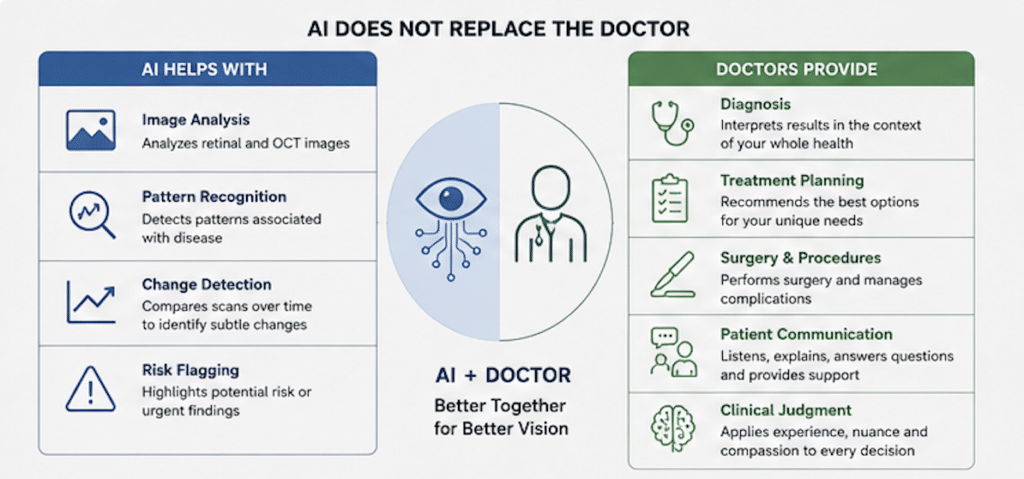
When used responsibly, AI can support earlier detection, improve consistency, and help doctors manage large amounts of information. But your eye care professional remains central to diagnosis, treatment, and long-term care.
What This Means for Patients
For patients, AI in eye care should not feel intimidating. In many cases, you may not even notice when AI-supported technology is being used. It may simply be part of how images are captured, analyzed, or reviewed.
What matters most is that your care remains thorough, personalized, and medically appropriate.
If you are coming in for an eye exam, cataract assessment, glaucoma evaluation, retina consultation, or surgical planning, advanced technology may help your doctor better understand your eyes. But the conversation still begins with you: your symptoms, your lifestyle, your concerns, and your goals.
At North Toronto Eye Care, our team is committed to providing advanced, patient-centered eye care. Whether you are due for a routine eye exam, managing a chronic eye condition, or exploring cataract or vision correction options, we are here to help protect your sight for the years ahead.
References
- American Academy of Ophthalmology. Artificial Intelligence Can Support Ophthalmologists, Not Replace Them.
- U.S. Food and Drug Administration. IDx-DR De Novo Classification Request and Indications for Use.
- U.S. Food and Drug Administration. IDx-DR v2.3 510(k) Summary.
- Health Canada. Pre-market Guidance for Machine Learning-Enabled Medical Devices.
- Health Canada, FDA, and MHRA. Transparency for Machine Learning-Enabled Medical Devices: Guiding Principles.
- American Academy of Ophthalmology. Diabetic Retinopathy Preferred Practice Pattern.
- Sheng B, Chen X, Li T, et al. An Overview of Artificial Intelligence in Diabetic Retinopathy and Other Ocular Diseases. Frontiers in Public Health. 2022.
- Zang P, et al. Deep-Learning–Aided Diagnosis of Diabetic Retinopathy, Age-Related Macular Degeneration, and Glaucoma Using OCT and OCTA. Ophthalmology Science. 2023.